Home Temperature and Indoor Plants: Mimic the Seasons
Today I photographed my apartment’s thermostat, because the temperature of the house is half of the growing, and hardly anyone talks about it.
TL;DR
- Indoor vegetables and herbs grow according to your home’s temperature, not only the light.
- In winter you need to heat a little, and in summer you need to cool.
- A cheap thermometer tells you more than how cold you feel.
- For most herbs and leafy greens, about 20 °C by day is a good starting point.
- Fruiting plants, like tomatoes, want a bit more warmth.
Continue reading
You can check the Products button at the bottom right to see what you actually need, but everything is optional.
- DHT22 temperature/humidity sensor
- ESP32 board
- Smart plugs
- Small clip fan
- AC unit (Cecotec ForceClima 9500)
- Heat mat
Why the house matters
Today I noted a reminder for myself: the home’s temperature matters, heat in winter, cool in summer, and mimic the seasons of the year.
I grow vegetables and kitchen herbs, not ornamentals. Each one has a range where it works well.
If the house stays cold, growth slows down. If it gets too warm, the plant burns through water, bolts and loses flavor.
Heating in winter
In Vitoria, autumn nights already fall to about 5 °C. Indoors, growing depends on the heating.
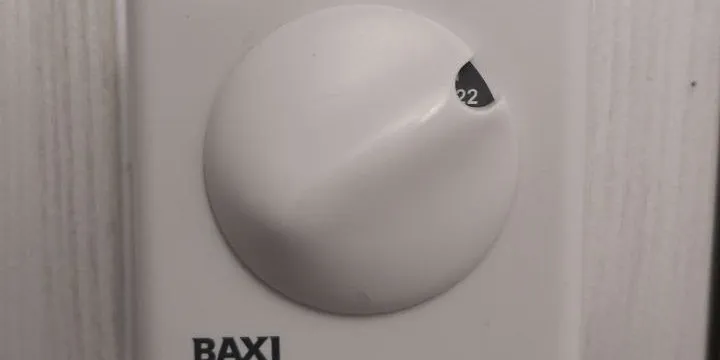
The photo shows the wall thermostat at home, with the dial pointing at 22.
That 22 is my usual setting. Heat builds up inside the cabinet, so it’s warmer in there than in the rest of the apartment.
Measure it with a sensor inside rather than trusting your hand.
Heating a 2x3 m room costs me about 5 € a month.
How much a cabinet heats up
A quick estimate, not a measurement. With the door closed, the light’s heat leaves through the walls until it balances out:
temperature rise (°C) = power (W) / (U x surface area)
U is how much heat the wall lets through. For a thin particleboard panel I take about 3.5 W per m² per degree. My 50x60x126 cm cabinet has about 3.4 m² of surface.
With a 10 W light and 22 °C outside: 10 / (3.5 x 3.4) = 0.8 °C, so about 23 °C inside. With 20 W, about 1.7 °C.
Close the cabinet up more or add watts and it goes up. Add ventilation and it comes down.
Cooling in summer
My summer brought a heat wave. I had to move the light schedule to night hours and add an air conditioner.
Heat and light together are what raise the temperature inside the cabinet. When the house is already hot, the light makes it worse.
For vegetables and herbs, above about 28 °C growth suffers and humidity climbs easily.
Mimicking the seasons
My idea is to imitate the seasons: cooler in winter, warmer in summer, with gentle changes rather than sudden ones.
Not every plant needs this. Leafy herbs cope well with a steady environment; some fruiting plants like a night a little cooler than the day.
Sudden swings stress plants more than a fixed temperature. If you change the thermostat, do it in small steps.
In upcoming articles I’ll cover estimating temperatures to mimic different environments.
How I keep an eye on it
A temperature and humidity sensor alerts me through Home Assistant when something leaves the range. To start, a min/max thermometer is enough.
What helps is checking the night minimum and the afternoon maximum, not just one reading.
FAQ
What temperature should I keep my home at for plants? For herbs and leafy greens, around 20 °C by day is a good starting point. Fruiting tomatoes and chillies like a bit more.
Will plants add much to my heating bill? It depends on your home and your tariff. For a 2x3 m room, it costs me about 5 € a month.
Do I need an air conditioner in summer? In a heat wave, I did. If your apartment stays cool, a fan may be enough.
Can I put a heater inside the cabinet? Better not. Heat the room, or use a heat mat for seedlings only.